Posts

Showing posts with the label CDISC

CDISC ODMv2 Development Progress: A 2018 Q1 Update

Image
Since starting work on ODMv2 last year the CDISC Data Exchange Standards Team, formerly known as the XML Technologies Team, has made substantial progress towards completing the backlog tasks and updates planned for ODMv2. Much of this work is progressing concurrently, creating a broad set of ongoing discussions. To follow the ODMv2 development work the best place to begin is the ODM-XML page in the XML Tech space on the CDISC Wiki, where you can find a list of the most recently updated pages, a link to the decision log, and links to other relevant aspects of the project. You can also find the notes from our meetings, and if you miss a meeting, a recording of it is available through the notes for a few weeks after the teleconference. The Data Exchange Standards Team's goal for 2018 is to release a first draft of ODMv2 for trial use by the end of year. We then plan to test and revise the draft for final release during 2019. This post, some of which was included in the Q4 201...
A Bit of Git for CDISC

Along with JIRA and the Confluence Wiki, CDISC has added the Atlassian Bitbucket distributed version control system to our online toolset. CDISC finally has a Git-based version control system, and several projects have already started using it. In cases where a standard is under development, the repository may be private to the team and not accessible by others. However, I anticipate a growing number of publicly accessible CDISC Bitbucket projects. The XML Technologies and SHARE teams are using Bitbucket and will have publicly accessible projects. Trace-XML is one such project. More on this in an upcoming post. You can find Bitbucket from the CDISC Wiki or JIRA by selecting the drop-down menu in the upper left-hand corner of either application, as shown in the graphic below. If you haven't used Git or Bitbucket before there are numerous online tutorials to get you started. Most code developed in a project of mine will have a repository on Bitbucket. That said, there are times...

Define-XML v2.1 – What do you think?

If you're wondering where the XML standards like Define-XML went on the CDISC website, they've moved. They're now located under Standards/Transport . If you go to the transport page  you can select from a fairly extensive menu of transport standards. There are a few transport options located elsewhere, such as Lab  and the Analysis Results Metadata  Define-XML extension. Our broad list of XML standards is in the process of welcoming a new version of Define-XML to the family. This new version of Define-XML, v2.1, will almost certainly be listed in the standards catalogs of regulatory authorities at some point, so all of you working on regulatory submissions should find this update interesting. There are a couple weeks left in the Public Review period (it ends on May 5th) so there's still time to add your comments. You can find the Define-XML v2.1 Public Review package  along with instruction for adding JIRA comments on the CDISC wiki . While Define-XML v2.1 is a m...

Clinical Research Track at the 14th FHIR Connectathon

Last weekend was the 2nd HL7 FHIR Connectathon (Jan. 14 & 15) that included a Clinical Research Track and the 14th overall FHIR Connectathon. This event was hosted on the Riverwalk in San Antonio and featured over 200 attendees for a weekends worth of hacking. The primary purpose of the Connectathon events is to provide a forum for participants to develop and test software in an informal way. During the previous, inaugural Clinical Research Track < http://wiki.hl7.org/index.php?title=FHIR_Connectathon_13> only two of us participated.  By the end of the weekend we were able to use FHIR resources to demonstrate the pre-populate Medidata Rave-based demographics and concomitant medications CRFs. The Clinical Research Track at the 14th Connectathon generated quite a bit more participation interest with 8 attendees. Representatives from vendors, sponsors, and standards organizations participated. Beyond the pre-population of CRFs using EHR data retrieved using FHIR, sever...

A Profile for Define-XML

As the CDISC XML Technologies team finalizes Define-XML v2.1 for internal review an old debate has re-surfaced: how much should the Define-XML specification focus on the regulatory submissions use case versus providing a more general specification that works for a broader set of use cases. As a standard that provides metadata to describe tabular datasets, Define-XML can be used to describe legacy datasets as well as datasets included for submissions. Define-XML has also been used as a specification for datasets. However, Define-XML became the most widely implemented ODM-XML based standard due its role as a required element of regulatory submissions. The importance of ensuring that Define-XML files included in a submission are complete and accurate makes a compelling case for adding rules that specifically target this use case at the risk of reducing its usefulness in other contexts. Having recently participated in the September HL7 FHIR connectathon in Baltimore, MD it strikes me ...

New Initiatives Highlighted at the 2015 CDISC Interchange

Lots of new initiatives showed promise at the CDISC 2015 Interchange conference in Chicago on November 9-13.  The EHR2CDASH (E2C) project demonstrated the potential of healthcare link technologies used with the CDISC standards. The E2C XPath statements used to grab HL7 C-CDA/CCD document content will be stored in SHARE to support the implementation of CDASH forms that can be pre-populated with EHR content. A group of CFAST TA standards development stakeholders reviewed the new processes and tools that will be used for developing the Prostate Cancer standard. BiomedicalConcepts continue to garner attention as a key element of the semantic layer in the CDISC standards model. The growing CDISC standards model so important to the SHARE work was on display during the poster session. Use of the ODM standard was highlighted, including an extension to support its use in modern hand-held devices. There was quite a bit of enthusiasm and interest in SHARE activities, as evidenced by the cr...

Promoting Data Sharing at the CDISC Interchange Conference

The theme of sharing clinical research data permeated a number of presentations at the CDISC International Interchange Conference this year. In fact, the opening plenary keynote presentation by General Peter Chiarelli, CEO of One Mind, highlighted the dire need for data sharing in clinical research and espoused a number of open science principles. One Mind defines open science as a “global movement to make scientific research, results and data available, and accessible to everyone.” The key goal behind this push for open science is to accelerate the research community’s ability to transform basic research into better clinical treatments for patients. You can find One Mind’s open science principles here http://onemind.org/Our-Solutions/Open-Science . One of One Mind’s open science principles involves adhering to widely accepted data standards. This makes sense because the standards help make the data useful. Sharing the data is not the end game. Using the data to accelerate the dev...

Value Level Metadata and Research Concepts

When people point to flaws in SDTM, they typically appear to me as gaps in the existing standard. In general, CDISC started defining standards by focusing on the basic structural metadata (e.g. domains, variables, code lists). This makes sense because this structural metadata is fundamentally useful, and relatively easy to understand and create. As the industry’s use of the standards has increased, so has the demand for standards that can be implemented more consistently and easily, as well as standards that are more computable. The limitations in the current standards are gaps, and addressing these gaps represents a natural evolution for the CDISC standards. As noted in my previous post “What’s in a SHARE Value Level Metadata Library?” CDISC does not currently contain Value Level Metadata (VLM) content, and this content represents a lot of new metadata. VLM is a gap in the existing standards. How do we know what variables are impacted by a specific –TESTCD? Much of that informati...

What’s in a SHARE Value Level Metadata Library?

What’s in a Value Level Metadata (VLM) Library? SHARE has the capability to store and publish Value Level Metadata (VLM) content. Currently, the only CDISC standard describing VLM is Define-XML. Define-XML provides the structure for VLM along with some guidelines on when it’s useful, but it does not provide standard VLM content. The Define-XML v2.0 specification states that VLM should be applied when it provides information useful for interpreting study data, and that it need not be applied in all cases. Precisely what and where VLM should be used is determined by study implementers. Since there are no hard and fast rules describing when to use VLM, what should be included in a SHARE library of VLM content? It might be useful to ask, “where is VLM being used today?” Based on input so far, most implementers add VLM where they think the regulatory reviewers might want to see it. Since many organizations are not yet using Define-XML as a machine-readable specification, but are inst...

Dataset-XML: an Expanding Toolbox

Despite just being released in Q2 of 2014, a number of freely available tools are already available to work with Dataset-XML files. The recently-introduced CDISC Dataset-XML standard enables the interchange of tabular datasets, like SDTM or ADaM, using ODM-based XML, and provides a convenient alternative to SAS V5 XPORT files. Tools supporting Dataset-XML are listed on the publicly accessible CDISC Dataset-XML Resources page on the CDISC Wiki. Early versions of many of these tools were available before Dataset-XML was released as a final standard. The speedy availability of these tools highlights the CDISC community’s culture of innovation as inspired by the availability of machine-readable standards. The availability of software tools with the release of Dataset-XML enabled the FDA to begin planning the "Transport Format for the Submission of Regulatory Study Data” pilot prior to the standard’s final release. In order to test Dataset-XML’s suitability as a replacement for SA...

May / June SHARE Update

During May and June the SHARE team has been busy on a number of fronts. In June we plan to begin beta testing the eSHARE site for machine-readable downloads of the CDISC standards.  The eSHARE site will be part of the new CDISC web site that will be launched in June. The SHARE team has also been actively designing new forms of standards content for SHARE, including Research Concepts and explicit Value Level Metadata representations. A white paper describing our initial solution for Research Concepts will be distributed for review in June. Also during June we plan to complete an initial proof-of-concept project towards a long-term Research Concept solution. Value Level Metadata (VLM) blog postings started in May and will continue through June. We plan to publish a white paper describing how VLM content will be represented in SHARE, and exported in Define-XML format, later in the summer. The SHARE Metadata Curators continue their work with the foundational standards teams to lo...

Value Level Metadata, Vertically Structured Datasets, and Normalizaton

Image
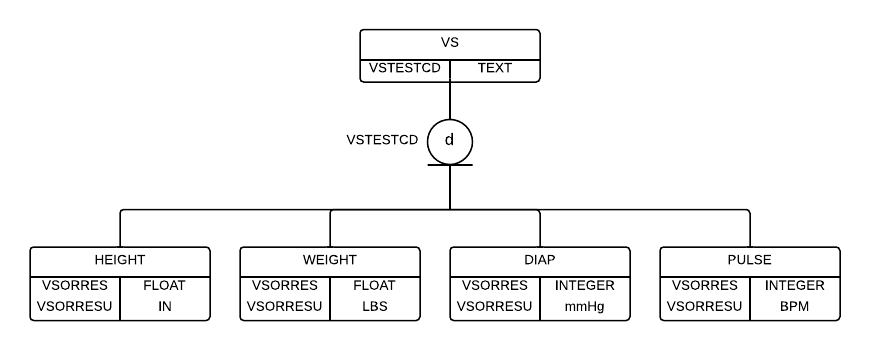
As part of the work to implement Value Level Metadata in SHARE, as well as to author a Define-XML Implementation Guide article, this will be the first of a series of posts on the topic of Value Level Metadata. These posts target a more technical audience, however the Define-XML IG article will include less technical jargon. Future posts will cover additional Value Level Metadata topics and examples. Value Level Metadata (VLM) is metadata that constrains a variable definition based on the value of another variable(s). VLM was originally specified in Define-XML v1.0 as a mechanism for providing the additional metadata needed for software to more accurately interpret these constrained variables.  For example, VSORRES is a variable with structural metadata of  DataType=”Text” and Length=”200”. However, when VSTESTCD=”DIABP” that definition is constrained by VLM to use DataType=”integer” and Length="3". In this case, the value of DIABP in VSTESTCD has triggered the application o...

April SHARE Update

Since the R1 library was moved into production at the end of January, the SHARE team has been hard at work on the R2 deliverables. Broadly speaking, R2 is focused around three main themes: (1) loading the remaining foundational standards, (2) publishing machine-readable standards to eSHARE, and (3) designing a solution for research concepts. On the first theme the SHARE curators are working with the SDS team to load SDTMIG 3.1.3, in addition to working on the import of SDTM IG 3.2. The curators are also working on the first controlled terminology update with the March release. On the second theme the team has implemented features to provide machine-readable standards exports, and has been testing these. The new CDISC web site will host this content for subscribers, and will be available for use this summer. Finally, on the third theme the team has been working on the requirements and a solution alternative for research concepts. A prototype of this solution will be implemente...

SHARE R1 is Done

SHARE is no longer merely a vision, idea, or plan. After nearly 6 months of implementation work SHARE R1, our first production library, has been completed. Woot woot! This is a major milestone. We've taken the first step on a long journey towards realizing the vision of transforming the CDISC standards into an end-to-end, interoperable set of metadata all available in a machine-readable format. Both SDTM 1.2 (IG 3.1.2) and CDASH 1.1 have both been loaded into the production SHARE Library. Using SHARE R1 we will load SDTM 1.3 (IG 3.1.3) and SDTM 1.4 (IG 3.2) in the coming weeks. Although the CDISC Controlled Terminology development and governance processes will remain unchanged, we will continue to load each newly released terminology package into SHARE. BRIDG 3.2 and the ISO 20190 data types have also been loaded into the R1 library. The theme for R1 was Machine-Readable Standards. The SHARE Team plans to publish metadata from SHARE for subscribers to download by the end o...
Metadata Curator Wanted Being a metadata curator means most won’t exactly understand what you do. You can certainly forget about explaining your job to your mom.  Traditionally, curators have managed collections of old stuff, like what you might find in a museum.  In today’s world of informatics and big data, however, metadata curators play an essential role in enabling metadata driven automation and semantic interoperability. At CDISC we are implementing the SHARE metadata repository  to manage the latest standards metadata, as well as the older stuff. The SHARE metadata curators will play a critical role in defining and administrating the processes and policies for governing the metadata that will become the CDISC standards. They will help to lead the CDISC community towards new ways of standards development.  In this capacity, the metadata curator must be a passionate advocate for clinical research data standards, a strong communicator, as well as an energ...

SHARE Sightings at the CDISC International Interchange

SHARE wasn't only the theme of this year’s International Interchange, it was also a launch of sorts. CDISC has certainly talked about SHARE at past Interchanges, but this year’s dialogue had a different quality to it. This was largely driven by the fact that the wrappers were taken off the SHARE software, and attendees actually got a preview of what’s coming. We’re still talking about the vision for SHARE, maybe more than ever, but we’re also talking specific features and functions, as well as when we’ll begin using the application. During the SHARE session on Thursday the SHARE Road Map was presented, the version of SHARE currently under development was demonstrated, and we saw how SHARE and CFAST fit together.  The release of SHARE R1 is planned for the first quarter of 2014. After initiating the project in 2007, and following a longish gestation period, the implementation is on target to deliver in a period of just under 6 months. We have a long way to go to fully realize t...